
Generative Engine Optimization (GEO) is the practice of making your website’s information easier for AI-powered search systems to discover, understand, evaluate, and potentially reference in their answers. It builds on solid SEO, but places extra emphasis on clear responses, factual support, and brand visibility when users ask conversational questions.
Businesses should not treat GEO as a trick for forcing ChatGPT or Google to cite a page. AI platforms use different systems, and no method guarantees an appearance. The practical goal is simple: create trustworthy resources people can use and systems can find.
This guide covers GEO vs SEO, a repeatable optimization workflow, realistic measurement, and common mistakes. For the Google-specific version, read my guide to ranking in Google AI Overviews.
What Is Generative Engine Optimization (GEO)?
Traditional search often starts with a list of pages. Generative AI search may instead create an answer using information it learned during training or retrieved from available sources. GEO is the work of making your brand and content more useful in this answer-driven environment.
Imagine a buyer asking, “What should a small business look for in an SEO consultant?” An excellent page explains the evaluation criteria, offers a realistic checklist, and shows how to assess claims. Such a page may be useful to both readers and systems assembling answers. Yet usefulness alone cannot guarantee a reference.
How Does AI Search Work?
AI answer products do not all work the same way. Some can search the web or retrieve documents before answering; others may respond from model knowledge or tools. When a system retrieves information, it may use a search index or another source-selection process to find material related to the question. The model can then synthesize an answer and, in some experiences, include citations or links.
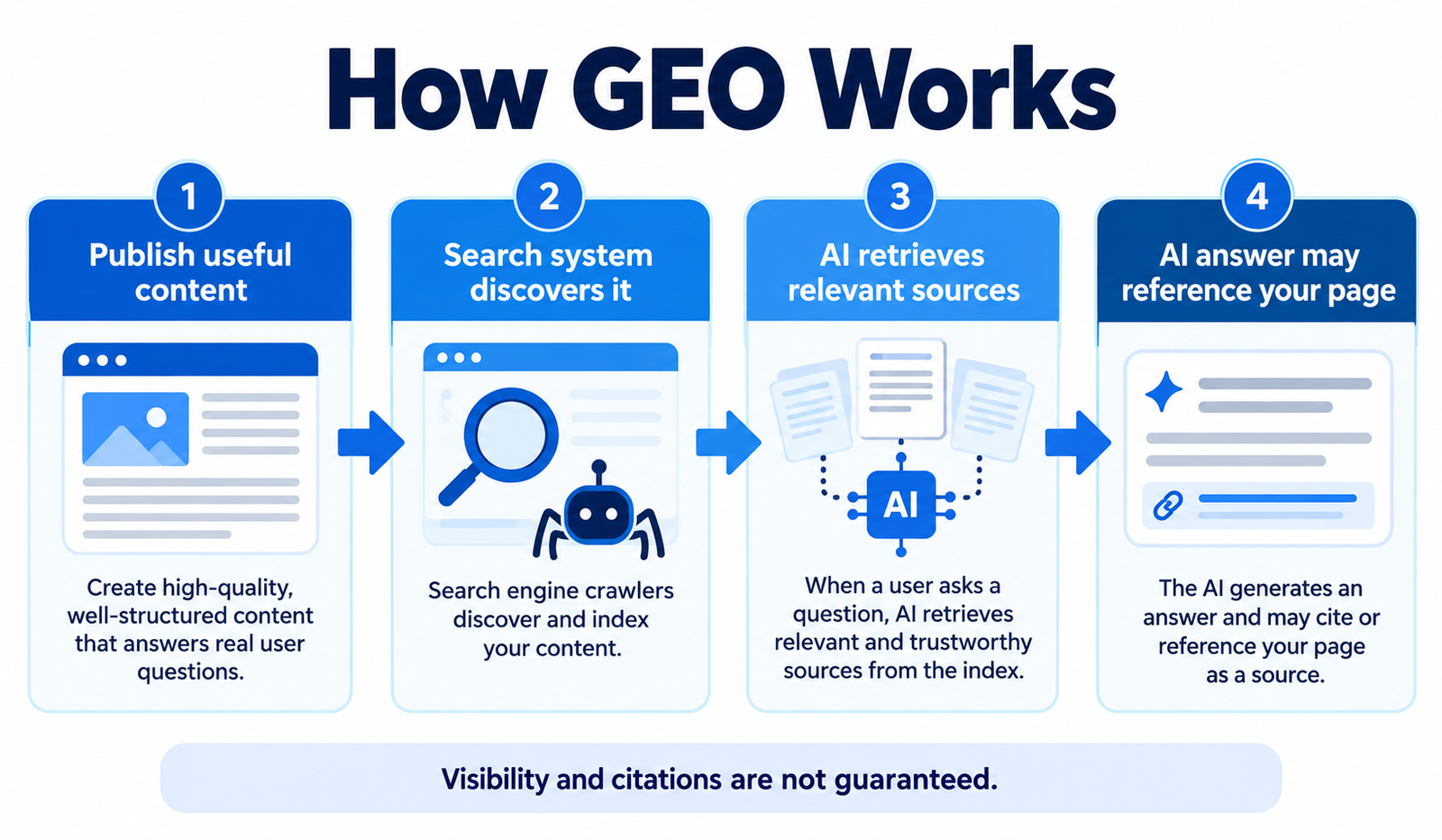
Google confirms that its AI Overviews and AI Mode rely on the fundamentals of Search and have no special GEO markup requirement. Indexable pages can be eligible as supporting links, but neither indexing nor inclusion is guaranteed. See Google Search Central’s AI features guidance.
GEO vs SEO: What Is Different?
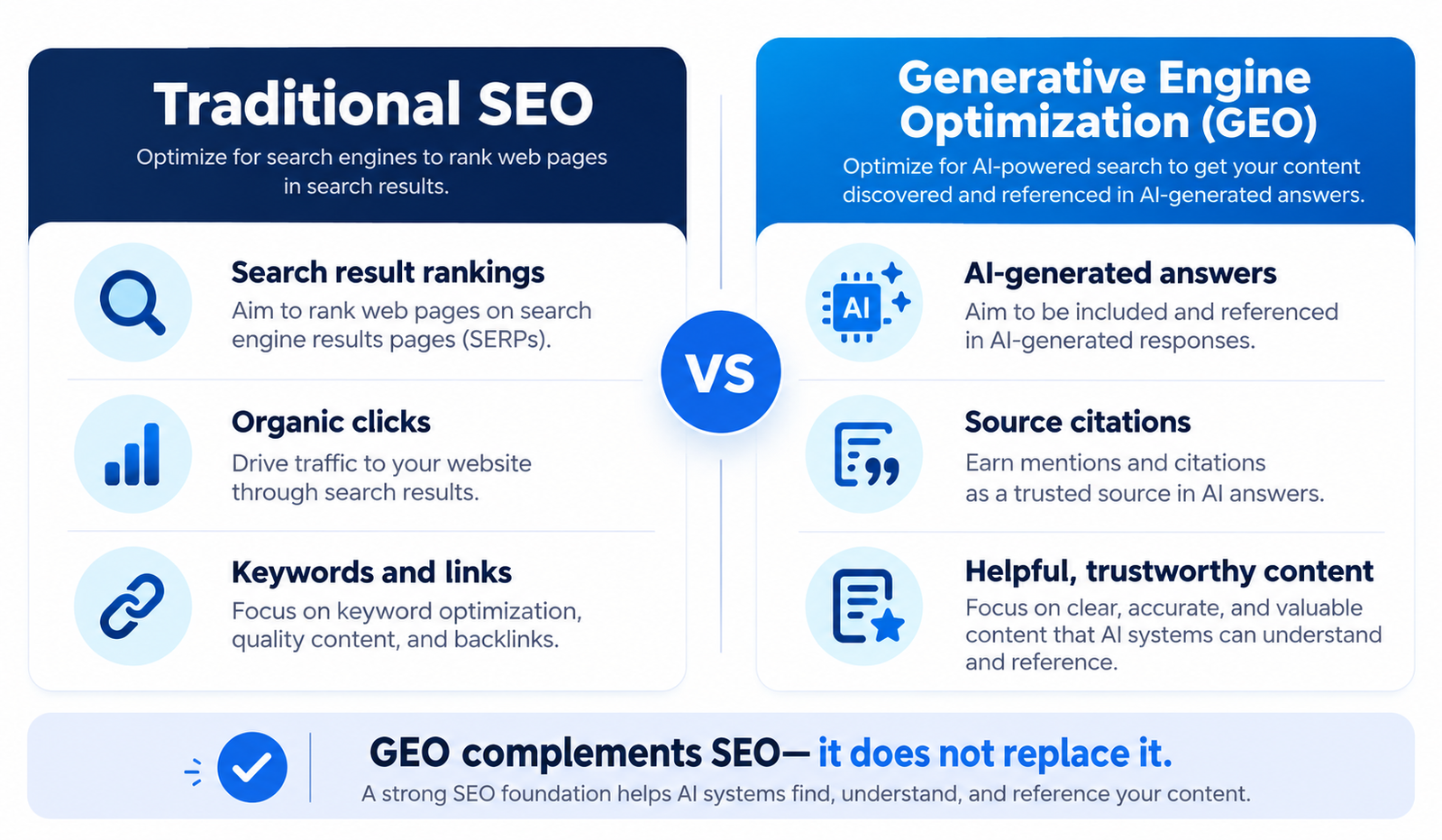
SEO and GEO overlap. Strong, accessible content gives you a foundation for both. The main difference is the outcome you are trying to observe.
| Factor | Traditional SEO | GEO |
|---|---|---|
| Main goal | Be found in organic search results | Be discoverable and possibly referenced in AI answers |
| Where people see you | Result listings, snippets and other search features | AI answers, citations, source links and brand mentions |
| Content emphasis | Relevant, useful pages with good technical foundations | Same foundations plus directly useful explanations and clear evidence |
| Measurement | Search impressions, clicks, positions and conversions | Referral traffic, observed citations, brand mentions and conversions |
| Main limitation | Rankings and clicks fluctuate | Citation behavior varies by platform and query |
Why GEO Matters for Businesses
Customers increasingly ask detailed questions before contacting a company. They may compare service providers, request product explanations, or ask for a recommended process. Useful GEO content gives them a reason to recognize your brand and investigate it further.
For example, a local service business can explain pricing factors, appointment steps, service areas, and maintenance advice. A software company can publish transparent comparisons and setup documentation. A freelancer can show a clear service process and examples of deliverables. All three are helping people make informed decisions, whether the eventual discovery happens through a classic result or an AI tool.
How to Optimize Your Website for AI Search
1. Start with customer questions
Collect questions from customer conversations, Search Console, site search, and relevant result pages. Group questions by intent: definition, comparison, problem-solving, or purchase. Give each page a distinct job rather than publishing several articles that answer the same question.
2. Answer clearly, then add depth
Open with a direct response. Follow it with examples, prerequisites, exceptions, and next steps. Use descriptive headings, concise paragraphs, and numbered instructions where they help. Do not force an FAQ onto every page just to appear “AI friendly.”
3. Publish original evidence
Add a real comparison methodology, screenshots you captured, firsthand observations you can verify, or practical examples. Label opinion as opinion. Cite original research for studies and statistics. Never invent client results, rankings, testimonials, or tests.
4. Make your authorship and business clear
Show who wrote or reviewed the content, when it was updated, and how users can contact your business. Explain relevant expertise accurately. Google emphasizes helpful, reliable, people-first content; a fabricated author bio or unsupported E-E-A-T claim does the opposite. See Google’s people-first content guidance.
5. Build a useful content network
A GEO guide should connect to related, non-duplicative resources. On my website, you can explore my SEO and content services, review selected projects, or learn more about my approach. Each link should support a real reader need.
Technical SEO, Structured Data, and GEO
Check your pages’ HTTP responses, crawl accessibility, canonicals, indexability, and internal links. Ensure that important information is available as readable text and that the mobile layout works. Structured data can describe articles, authors, breadcrumbs, and organizations accurately, but there is no special schema that guarantees AI citations.
If you add Article or BlogPosting markup, ensure the author, publication date, headline, and image are accurate. Match markup with visible content. Avoid fake ratings and unrelated FAQ schema. Google’s structured data guidelines explain why eligibility is not a promise of rich-result display.
You can also improve helpful images and videos with descriptive context, while keeping files compressed and layouts responsive. Your objective is better comprehension and usability, not a secret AI-only technical switch.
How to Measure AI Search Visibility
GEO reporting is less standardized than classic organic SEO reporting. Look at your real referral sources in analytics, monitor assisted conversions and branded searches, and carefully record when your site is visibly cited in a relevant AI answer. Repeat checks across time and queries; one screenshot is not a stable ranking.
Google Search Console provides useful performance reporting for Search, including Google AI features within broader reporting, but it does not function as a universal, platform-by-platform AI citation tracker. Do not describe an estimate from a third-party visibility tool as verified search traffic. Focus on leads, sales, signups, and useful visits, not vanity mentions.
GEO Optimization Checklist
| Action | Why it matters | Practical implementation |
|---|---|---|
| Map search intent | Answer the right question | Group real queries and review competing content |
| Write a direct answer | Make information easy to use | Add a clear summary near the start |
| Add verifiable value | Improve trust and distinctiveness | Use genuine examples and primary sources |
| Fix technical issues | Support discovery | Inspect crawling, indexing and canonicals |
| Link related pages | Help readers explore | Use descriptive links between relevant content |
| Review analytics | Judge business impact | Compare referral activity and conversions |
Start with your five most useful existing pages. Improve the answers, update any outdated material, check links, and log the results before expanding into new topics.
Common GEO Mistakes to Avoid
- Making promises: No consultant can guarantee a ChatGPT citation or a Google AI Overview.
- Copying competitors: Rewriting common advice adds little new value.
- Publishing duplicate intent: Multiple near-identical posts confuse readers and your content plan.
- Ignoring indexing: Useful content still needs a healthy technical foundation for Google Search.
- Overusing schema: Unsupported markup does not create special GEO eligibility.
- Chasing mentions alone: Visibility means more when it leads to qualified visitors and customers.
Want Your Website to Appear in AI Search?
Improve your website’s visibility across traditional search and AI-powered search experiences with a practical SEO and GEO strategy. Work with Muhammad Talha to improve your content, technical SEO, and search visibility.
Frequently Asked Questions
What is generative engine optimization?
GEO means improving content’s accessibility, clarity, credibility, and usefulness so AI search experiences can potentially discover and reference it.
How is GEO different from SEO?
SEO primarily tracks visibility and outcomes in search results. GEO considers additional AI answer citations, mentions, and referrals while relying on the same quality foundations.
Can GEO help a website appear in ChatGPT?
Helpful, publicly accessible content may improve discoverability in retrieval-enabled experiences, but ChatGPT visibility and citations are not guaranteed.
How do you optimize for Google AI Overviews?
Follow Google’s SEO requirements, provide original helpful content, use clear structure and accurate evidence, and ensure pages are indexable and eligible for snippets.
Is schema markup required for GEO?
No. Google says no special structured data is required for AI Overviews or AI Mode. Use supported markup to describe visible content accurately.
How can businesses measure AI search visibility?
Monitor identifiable referral visits, conversions, branded demand, and documented appearances in AI responses. Treat third-party citation estimates cautiously.
Final Thoughts
The best GEO strategy in 2026 is not to abandon SEO. Build trustworthy pages that answer important questions, demonstrate their claims, load well, and connect to helpful resources. Measure results honestly and refine your strongest content over time.
I’m Muhammad Talha, an SEO specialist and content writing expert. If you want a practical plan tailored to your website and customers, contact me to discuss your SEO and GEO opportunities.
Pingback: Answer Engine Optimization (AEO): Strategies That Work in 2026 - talhaseo.com
Pingback: AI SEO vs Traditional SEO: What’s Changing in 2026? - talhaseo.com