
Answer Engine Optimization (AEO) means making your website’s content clear, useful, and accessible so answer-focused search features can understand it and potentially present it to people asking questions. AEO can support visibility in featured snippets, some voice responses, and other answer experiences. It builds on search engine optimization rather than replacing it.
In 2026, people ask detailed questions and often expect a useful explanation before clicking. The best response is not to publish hundreds of short answers. It is to make the right information easy to find, verify, and act on. Here are practical strategies you can apply, plus ways to measure whether they help your business.
What Is Answer Engine Optimization?
AEO is a useful name for improving content for question-led search. Think of a customer asking, “How long does a technical SEO audit take?” The page should answer that question plainly, explain what changes the timeline, and outline the audit steps. A searcher can understand the response without guessing what the business means.
There is no single official AEO ranking system. Different products choose and display answers differently. Google also states that its AI Overviews and AI Mode have no extra technical requirements beyond established Search practices. Treat “AEO strategies” as practical content and technical improvements, not as guaranteed placement tactics. Google’s AI search guidance explains the distinction.
How Do Answer Engines Work?
Search engines discover pages, evaluate relevance, and decide which information to show. A traditional search result links to a page. A featured snippet may display a passage from a page directly in the results. A voice assistant may read out a brief answer. Some AI-powered experiences synthesize material from multiple sources.
These mechanisms are not identical. For instance, a featured snippet is selected automatically by Google’s systems; there is no special HTML tag that forces it to appear. Likewise, using FAQ structured data does not guarantee a question-and-answer presentation in Search.
One useful principle holds across them: a reader should quickly see what question a section answers, which details support that answer, and where to go next. Keep the key explanation in visible text and avoid relying on decorative graphics alone.
Why AEO Matters in 2026
An answer-focused page can help people compare services, solve problems, or decide when to contact a specialist. A local business could explain what a consultation includes. A software company could show setup steps with screenshots. An SEO freelancer could clearly explain when to choose an audit over ongoing SEO work.
That makes AEO a useful part of content planning. Even when an answer appears without a click, a well-presented brand and helpful source may be remembered. Yet being quoted is not automatically a lead. Track whether visitors still engage, enquire, and become customers.
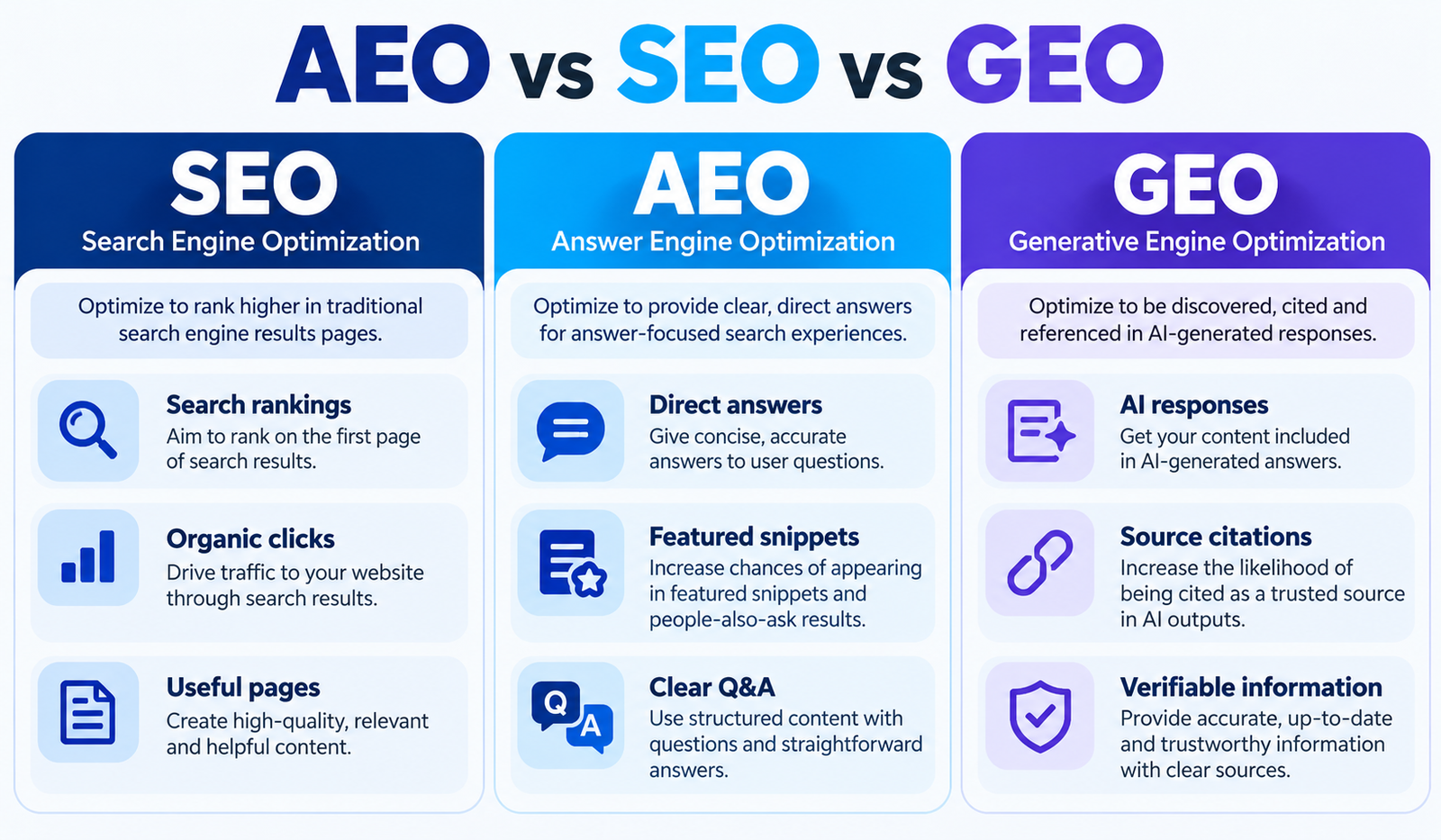
AEO vs SEO vs GEO
The terms overlap and marketers sometimes use AEO and GEO interchangeably. The following distinctions are helpful for planning, not rigid labels used by every platform.
| Area | SEO | AEO | GEO |
|---|---|---|---|
| Primary aim | Earn visibility in organic results | Make helpful responses easy to surface | Support discoverability in generative answers |
| Typical surfaces | Search results and site links | Featured snippets and direct-answer features | AI-powered answer and citation experiences |
| Main work | Crawlability, relevance, quality and links | Clear question responses and useful presentation | Source clarity, original evidence and technical foundations |
| Content shape | Useful pages matching search intent | Concise answers with relevant context | Credible explanations, distinct value and supporting sources |
| Tracking | Clicks, impressions, conversions | Observed answer appearances and outcomes | AI referrals, citations and brand mentions |
For a wider look at citations and generative systems, read my Generative Engine Optimization guide. For Google’s specific AI search experience, see my Google AI Overviews SEO guide. Those resources cover topics this AEO checklist does not need to repeat.
AEO Strategies That Work in 2026
1. Identify questions with real intent
Use Google Search Console, customer emails, sales calls, and onsite search to find questions that matter. Sort them into definitions, comparisons, instructions, and buying decisions. A question with low traffic but high purchase intent may be more valuable than a broad informational phrase.
Before creating a new URL, check whether an existing page already answers the question. Add a targeted section when it fits; create a separate article only when the need is genuinely different.
2. Put a direct answer near the question
Use a meaningful heading followed by a short answer. For example: “A technical SEO audit checks crawlability, indexing, page performance, and other website issues that can limit search visibility.” Then explain the process and exceptions. Do not chase an arbitrary word count for every answer.
A precise response should still be accurate. If the answer depends on product type, location, price, or use case, state those limits instead of oversimplifying.
3. Format content for the task
Use numbered steps for instructions, bullets for short considerations, and comparison tables for competing options. Give headings natural wording. Add concise definitions when technical terms appear. These structures help human readers and can make the page easier for systems to interpret.
For example, a guide to canonical URLs needs a definition, an implementation example, and a warning about common mistakes. A comparison of two services needs consistent decision factors instead.
4. Improve your chances of a useful featured snippet
Review the current results for a specific question. If Google shows a definition, explain the concept clearly. If it shows steps, provide an accurate step sequence. A table may be helpful for genuine comparisons. Google’s systems still choose snippets automatically, so there is no guaranteed formula.
5. Demonstrate real trust and expertise
Identify the author, describe relevant experience accurately, and support technical claims with original references. Show working examples or real observations when available. Do not invent testimonials, results, clients, or statistics. Google’s people-first content guidance prioritizes information made to genuinely help visitors.
6. Use structured data when it fits
Article, Breadcrumb, or Organization markup can describe page information clearly when implemented correctly. It must match the visible page. Google limits FAQ rich results primarily to well-known authoritative government and health sites, so ordinary service blogs should not expect FAQ snippets just from adding markup. See Google’s FAQ structured data guidance.
7. Keep pages technically accessible
Make sure important URLs can be crawled and indexed, serve useful HTML, have appropriate canonicals, and work on mobile. Keep images compressed and avoid overlays that hide the answer. Submit a sitemap if needed, but remember that a sitemap does not guarantee indexing.
8. Support conversational and voice questions
People often phrase voice questions as complete sentences. Write naturally enough to answer them, but do not create repetitive “near me” paragraphs or hundreds of artificially varied question pages. When local context matters, provide real service details, business information, and relevant location guidance.
9. Maintain and connect your useful content
Revisit pages after real product, policy, or industry changes. Correct outdated advice. Link readers to the next helpful step, such as your SEO and content services or a relevant example in your project portfolio. The link should help the reader, not simply repeat a target keyword.
How to Measure AEO Performance
For traditional Search, watch Search Console query impressions, clicks, click-through rates, and page trends. Check priority searches to record featured-snippet appearances, while recognizing that presentation may vary by location, device, and time.
Use website analytics to connect traffic with meaningful outcomes: form enquiries, consultation requests, purchases, or returning visits. Where attribution is available, compare referral sources from AI-powered products. Never present estimates from third-party visibility tools as confirmed Google metrics.
Build a simple log: page, target question, edit date, observed search feature, organic performance, and conversion impact. Compare periods fairly. A citation with no qualified interest may be less valuable than a smaller number of relevant visitors.
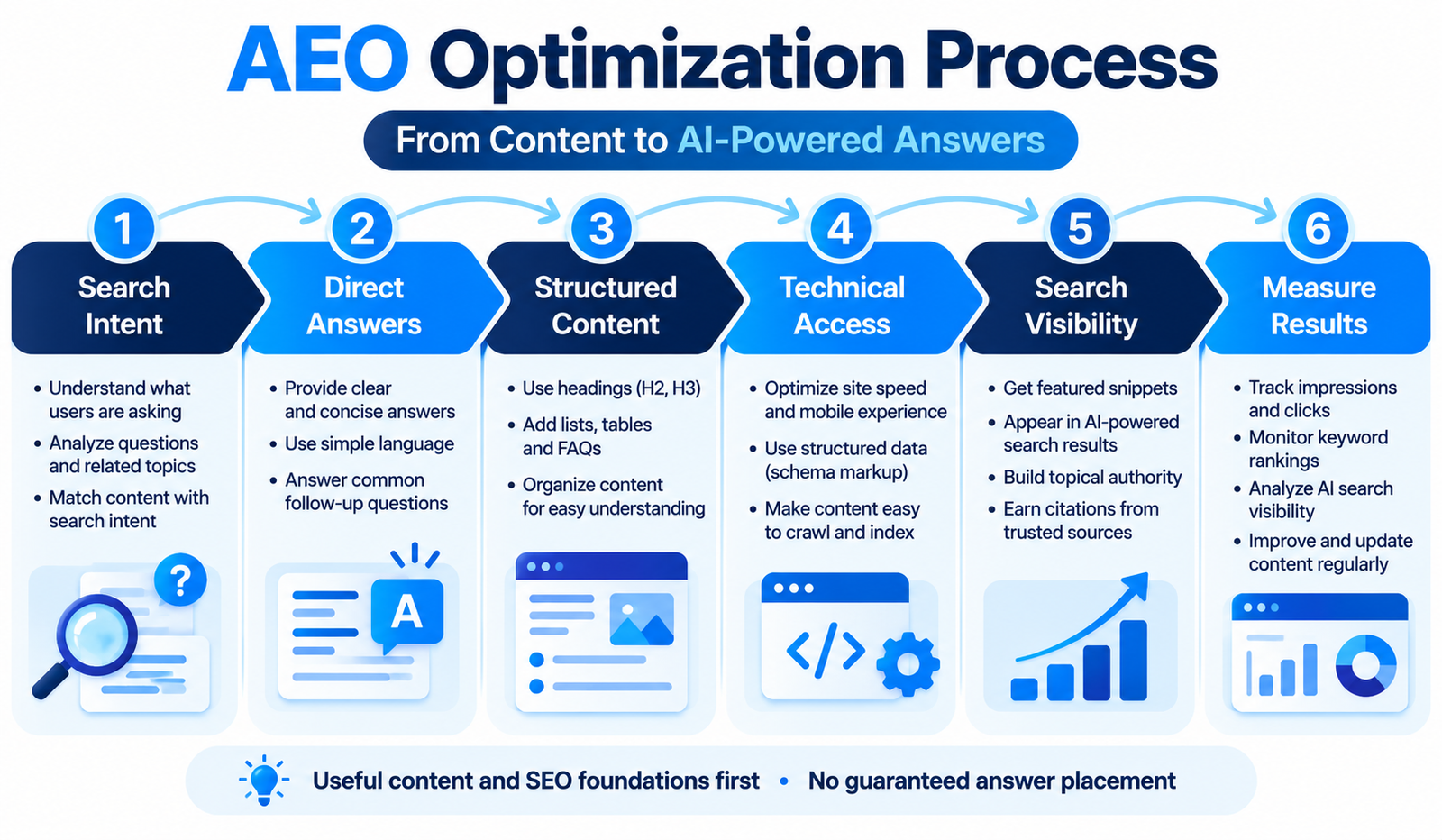
Practical AEO Checklist
| Action | Why it matters | How to implement | What to measure |
|---|---|---|---|
| Research user intent | Find worthwhile questions | Review queries and customer conversations | Relevant query impressions |
| Answer directly | Reduce searcher effort | Use a clear summary beneath the heading | Engagement and answer appearances |
| Add evidence | Build trust | Cite original sources and show real examples | Qualified visits |
| Improve structure | Make content scannable | Use steps, lists and comparison tables | Page engagement |
| Check accessibility | Support discovery | Test indexing, mobile pages and internal links | Coverage and crawl issues |
| Update content | Avoid stale advice | Revisit when facts change | Long-term performance |
| Make conversion easy | Connect information to business value | Offer a relevant contact or service link | Enquiries and leads |
Start with three established pages that already bring relevant visitors. Improve those before creating new articles. This makes it easier to compare the effect of your edits and reduces accidental competition between pages.
Common AEO Mistakes
- Keyword stuffing: Repeating the exact question adds noise instead of useful context.
- Unverified claims: Fabricated “experiments” and numbers weaken trust.
- Misused schema: Markup cannot force Google to display a rich answer.
- Overlapping pages: Multiple articles with the same purpose confuse readers and content planning.
- Ignoring users: A short answer without context can mislead more than it helps.
- Chasing appearances alone: Measure leads and value, not just screenshots of search features.
Frequently Asked Questions
What is Answer Engine Optimization (AEO)?
AEO is the practice of improving content clarity, relevance, accessibility and trust so search systems can potentially surface useful answers to user questions.
How is AEO different from SEO?
SEO supports visibility across organic search. AEO emphasizes making specific responses easy to understand and potentially display in answer-focused features.
What is the difference between AEO and GEO?
AEO often focuses on direct-answer experiences; GEO often describes being discovered or referenced in generative AI responses. Their foundations overlap.
How can I optimize my website for answer engines?
Research real questions, answer them accurately, add supporting evidence, use suitable formatting, fix crawl issues, and measure relevant visits and conversions.
Does structured data help AEO?
Valid structured data can explain page information, but it neither guarantees an answer box nor creates a special AI Overview requirement.
How do I measure AEO performance?
Combine Search Console reporting, consistent checks of relevant results, analytics referrals, and qualified conversions. Recognize that no tool covers every answer system perfectly.
Want to Improve Your Website’s Visibility in AI Search?
Make your content easier for search engines and AI-powered answer experiences to discover and understand. Work with Muhammad Talha to build a practical SEO, AEO, and GEO strategy for your business.
Conclusion: Make Your Answers Worth Finding
Answer Engine Optimization works best as a practical extension of people-first SEO. Understand what users need, answer with care, support claims, keep pages accessible, and review the results. No single schema, paragraph format, or tool can guarantee selection by a search or AI system.
I’m Muhammad Talha, an SEO specialist and content writing expert. If you need help improving your site’s content and search visibility, get in touch to discuss your website.
Pingback: AI SEO vs Traditional SEO: What’s Changing in 2026? - talhaseo.com